Feeling as I do that there's way too much emphasis on using "scales" to organize musical thoughts, I waited as long as possible before "learning all my scales." But now it's unavoidable. Permutations to follow as I work them out. The hollow circles represent the lowest roots, and the numbers with "^" over them are the scale degree. Note that these patters have a compass of exactly two octaves, one more thing I love about GDAD tuning.
Sunday, September 29, 2013
Tuesday, June 25, 2013
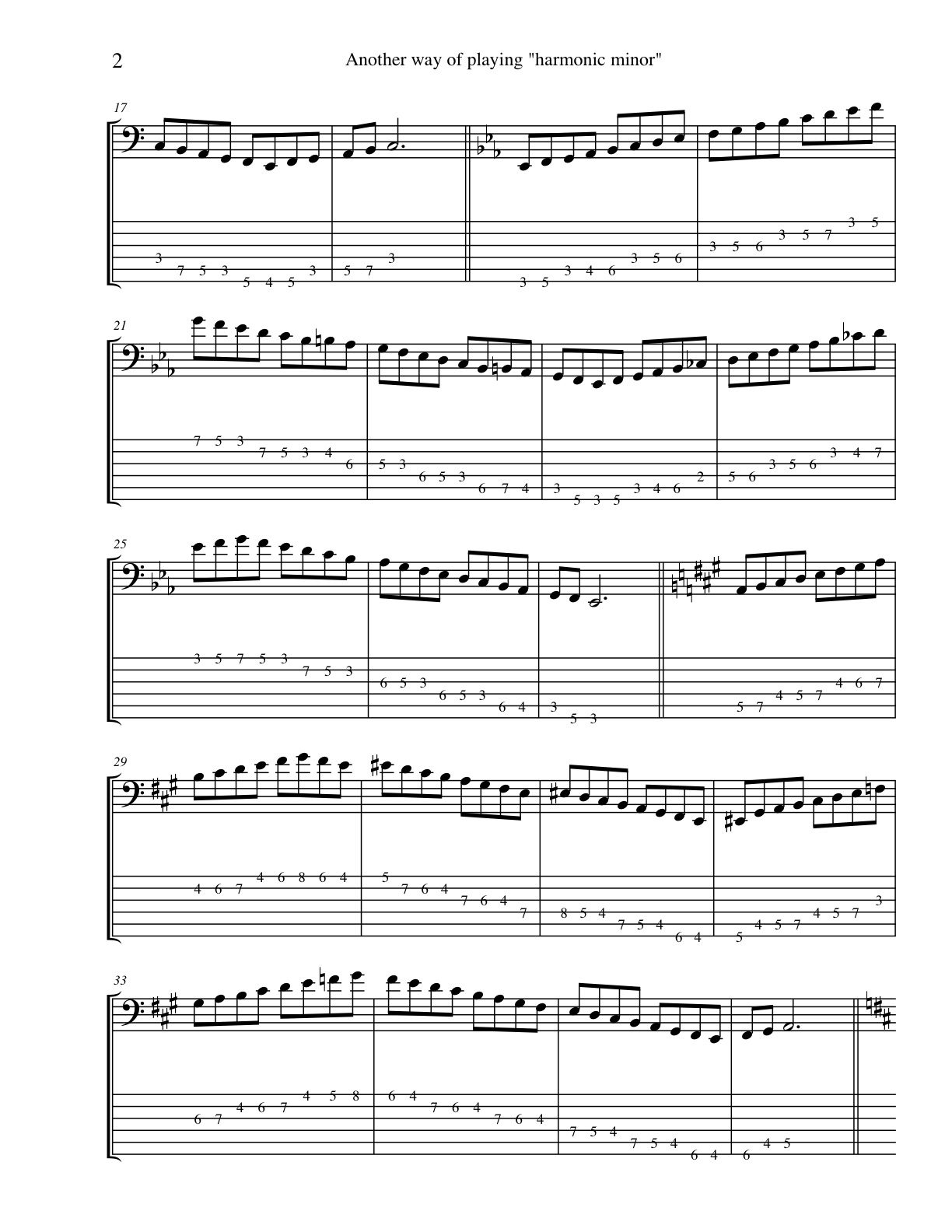
6-string bass scales - another way to think about "Harmonic Minor"
Most of the cases in which you would deploy a "harmonic minor" sound are in the ii -V part of the minor cadence. Once you reach the target minor chord you are free from a specific mode constraint. The scale tonic is actually rather insignificant until the one-minor chord has been reached.
Here's a scale exercise that reflects this aural reality. You'll notice two different ways of altering a major scale to sound the relative minor.
Friday, June 21, 2013
scales for guitar - Another way to think about "harmonic minor"
Most of the cases in which you would deploy a "harmonic minor" sound are in the ii -V part of the minor cadence. Once you reach the target minor chord you are free from a specific mode constraint. The scale tonic is actually rather insignificant until the one-minor chord has been reached.
Here's a scale exercise that reflects this aural reality. You'll notice two different ways of altering a major scale to sound the relative minor.
Sunday, May 26, 2013
Lester Young on "Back Home in Indiana"
It always makes sense to transcribe Prez' version of the head, that's the first chorus in Ab, after which he modulates to F. He actually takes 4 or 5 choruses on this cut, though I only did the first and a couple of bars of the second.
Quarter notes whether on or off the beat should generally be understood to be held for less than their written length, but using the articulation (^) would in most cases be giving it too heavy an accent. The chord changes are the generally understood stock changes for "Indiana." There might be some variants in the recording (I think the piano player is Teddy Wilson) but again, I don't have it to hand to refer to. In any case, while making lead sheets I believe in providing the simplest possible version of the changes.
I love the leisurely ascending line at the top of the first blowing chorus. Note also how bars 42 - 49, three distinct phrases, are tied together by the stepwise line F-E-D-C. The way he articulates dominant 7ths - or doesn't - is worth a look. Only once does he play the third (E) of the dominant C7. He is much more likely to play something "chord specific" over the secondary dominants G7 and D7. My own observation is that playing to the actual chord of the moment only becomes more necessary - if ever - the farther you go from the original key.
However, the main thing I'm picking up from this solo is how each phrase is kept within a relatively small range: see for example the two phrases between bars 58-61, and 62 (starting beat 4 of 61) - 64. I would actually say that this phrase extends through the half-note rest in bar 65. Tightly focused phrases like these make it more possible to connect one to another, the way these two are.
I remember my first whack at taking down this solo. I loved it of course in kind of an "awww, ain't dat sweet?" sort of way. Before long upon being struck by the level of deep organization and craft that went into this seemingly tossed-off gem, I quailed I'LL NEVER BE ABLE TO DO THAT!! and - I admit, using Lester's own words - "so I went away and shed my little tears, you know?"
Monday, April 15, 2013
Boston
At times like this, those of us who consider ourselves "artists" of one sort or another may do well to remember our potential to put beauty somewhere it isn't. A powerful weapon indeed, and one that in some places takes real actual courage to deploy, as opposed to, say, putting a bomb in a trash can.
Tuesday, March 12, 2013
Thursday, February 21, 2013
6-string Bass 7th-chord Arpeggios
The other night on the gig, I was muddling through the usual way and thinking "what happened to all that stuff I've been practicing at the last two weeks?" Suddenly, some time in the second set it just...dropped into my brain. It was like the moment in The Wizard of Oz where it went from black and white to color. It wasn't "remembering" per se, but a sensation more like being present at the formation of a synapse. Totally made my night! This is what I'd been messing with:
These can be hard to print off this page, so anybody who likes these may feel free to e me and I'll email you back the Jpegs. Also my at my website, www.countjockula.com you can buy The Big Ol' (USEFUL) Book of Scales and Arpeggios, which is also volume 3 of The Electric Bass Book. It's for 4-string basses, but the ideas there can be applied to 6-string easily enough.
Subscribe to:
Posts (Atom)