Tuesday, December 3, 2013
Sunday, November 24, 2013
Sunday, November 3, 2013
The Mandolin Diaries - some hip 7th chords to use on "Assanhado"
Jacob do Bandolim's "Assanhado" is one of those tunes - like "Sweet Georgia Brown," "There Is No Greater Love," "Lazy River" et al - that can be a veritable study in dominant 7th chords. The tune is in A, but sooner or later you run through Bb7, F7, C7, G7, D7, A7 and E7. What with all the chord voicings available on mandolin in GDAD tuning, there's a lot to explore. Here's some hip 7th and 9ths for the B-section.
Then some arpeggio exercises which should be self-explanatory. You can also do these diatonically.

Then some arpeggio exercises which should be self-explanatory. You can also do these diatonically.

Monday, October 7, 2013
Sunday, September 29, 2013
The Mandolin Diaries - major scales
Feeling as I do that there's way too much emphasis on using "scales" to organize musical thoughts, I waited as long as possible before "learning all my scales." But now it's unavoidable. Permutations to follow as I work them out. The hollow circles represent the lowest roots, and the numbers with "^" over them are the scale degree. Note that these patters have a compass of exactly two octaves, one more thing I love about GDAD tuning.
Tuesday, June 25, 2013
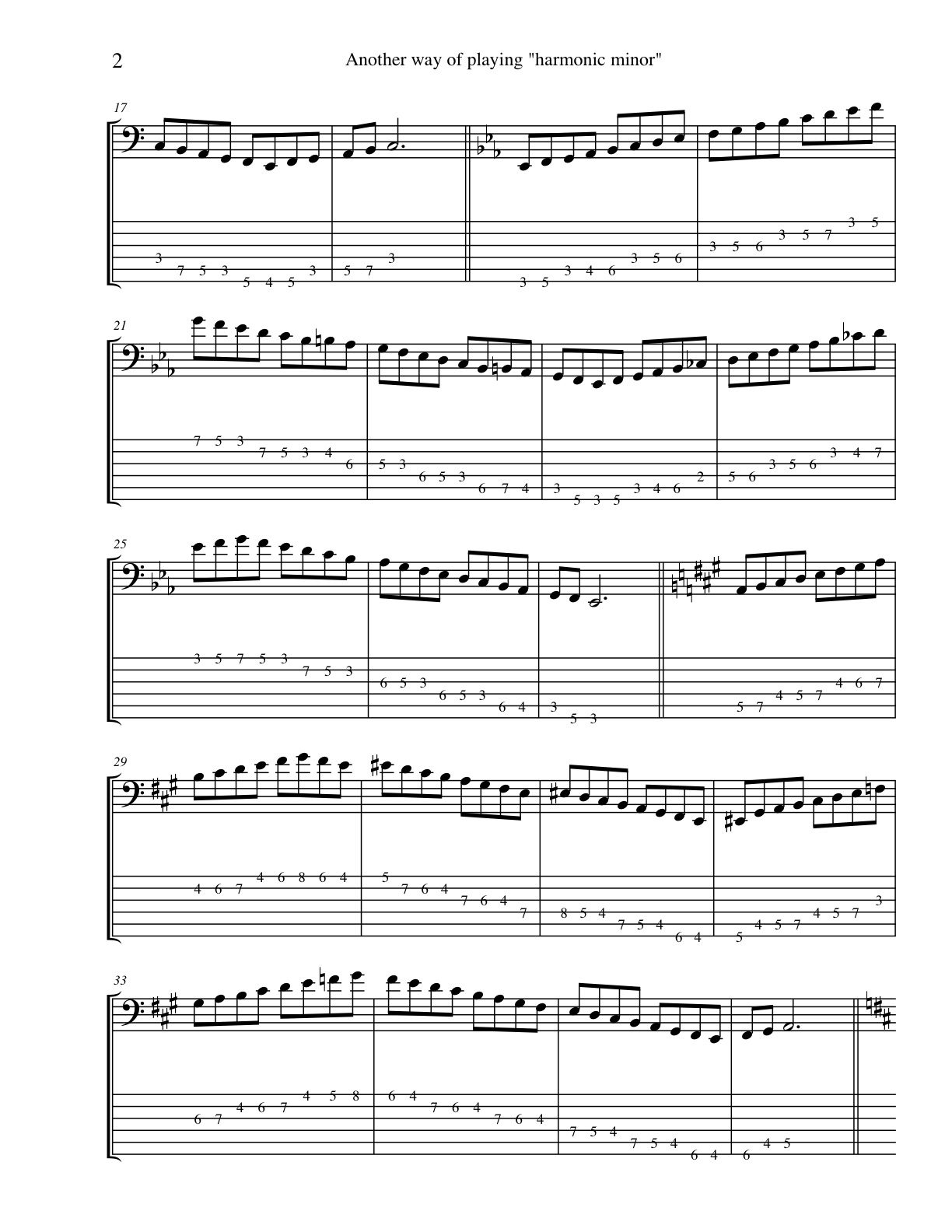
6-string bass scales - another way to think about "Harmonic Minor"
Most of the cases in which you would deploy a "harmonic minor" sound are in the ii -V part of the minor cadence. Once you reach the target minor chord you are free from a specific mode constraint. The scale tonic is actually rather insignificant until the one-minor chord has been reached.
Here's a scale exercise that reflects this aural reality. You'll notice two different ways of altering a major scale to sound the relative minor.
Friday, June 21, 2013
scales for guitar - Another way to think about "harmonic minor"
Most of the cases in which you would deploy a "harmonic minor" sound are in the ii -V part of the minor cadence. Once you reach the target minor chord you are free from a specific mode constraint. The scale tonic is actually rather insignificant until the one-minor chord has been reached.
Here's a scale exercise that reflects this aural reality. You'll notice two different ways of altering a major scale to sound the relative minor.
Subscribe to:
Posts (Atom)